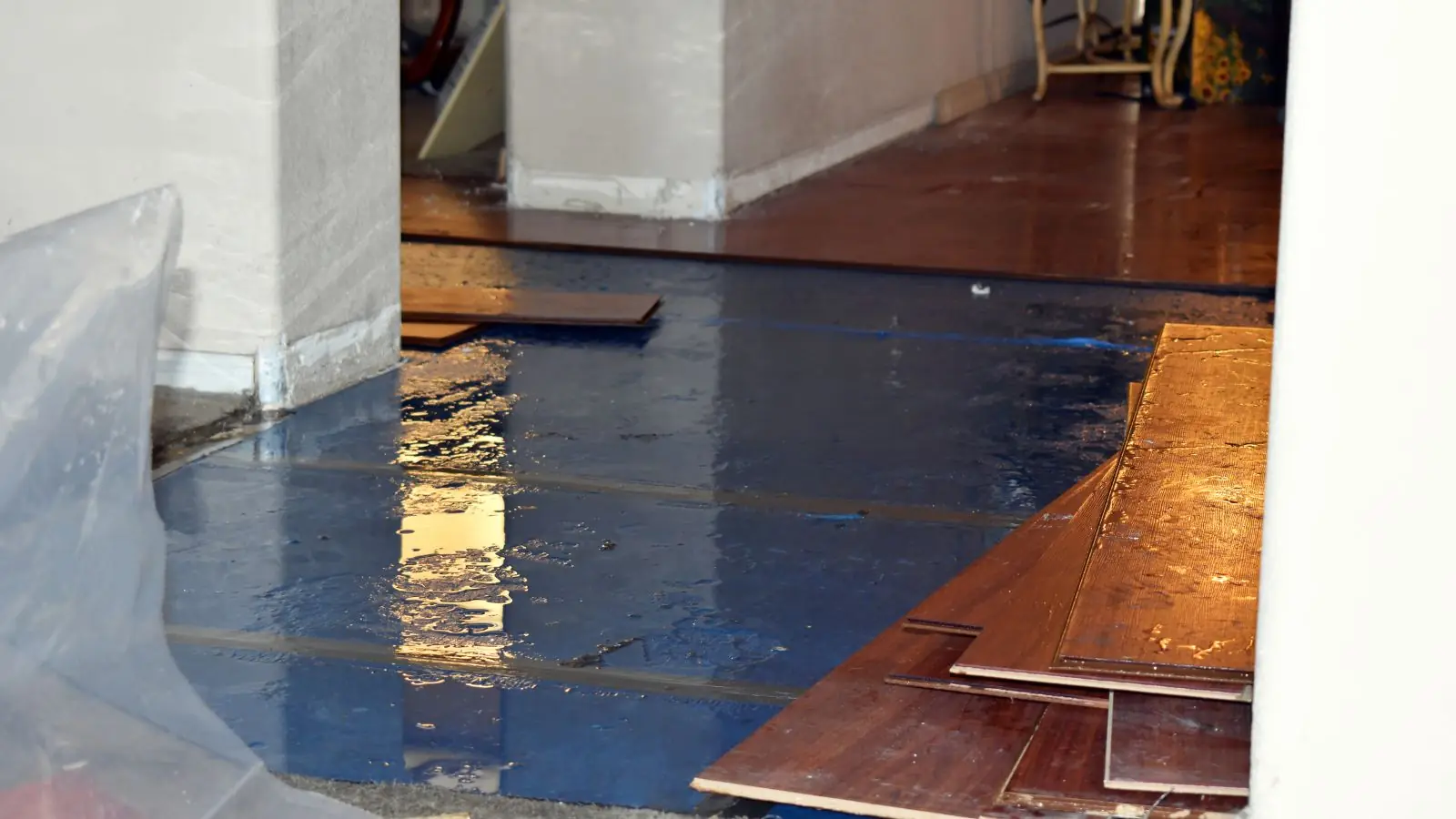
Wood floor water damage repair in Lake Forest, CA means drying the boards and the subfloor under them, then deciding which pieces can be refinished and which must be replaced. Wood takes on water slowly and gives it back slowly, so the damage you see on day one is rarely the full picture.
Most of the calls we get about floors start with a small, quiet leak. A dishwasher supply line weeps, a refrigerator ice maker line drips behind the unit, and a week later the boards near the kitchen start to rise. This guide explains what the floor is doing and what the options are.
Cupping, crowning and what they tell you
Cupping is when the edges of a board rise higher than the center, so each plank looks like a shallow dish. It usually means the underside of the board took on more moisture than the top. Water came from below, from the subfloor, or from a slab that stayed damp.
Crowning is the reverse. The center of the board is higher than the edges. It often shows up after a cupped floor has been sanded while still wet, or when water pooled on the surface and soaked in from above.
Neither shape is a verdict by itself. Many cupped floors flatten again as they dry, which can take weeks, not days. Sanding too early is the classic mistake because the board is cut flat while swollen, then shrinks and leaves a crown.
Gaps between boards after drying are also common. They tell you the wood swelled, pushed against its neighbors, and shrank back.
How moisture in the subfloor is actually read
Looking at the surface is not enough. Crews use a pin or pinless moisture meter on the boards and a second reading on the subfloor beneath. A thermal imaging camera helps trace where water spread, because wet material reads cooler than dry material nearby.
Readings only mean something against a reference. Under ANSI/IICRC S500 practice, drying goals are set against a dry reading taken from similar, unaffected wood elsewhere in the home. A board is not dry when it feels dry. It is dry when it matches that reference.
Engineered wood and laminate need extra care because the layers hold water differently. A plywood core can stay wet long after the top veneer looks fine. A fiberboard core in laminate soaks up water at the seams and may swell permanently.
That is why the daily readings matter. If numbers stop falling, something is trapping water, and the crew needs to find it.
| Floor type | How it reacts to water | Usual outcome |
|---|---|---|
| Solid hardwood | Cups or crowns, gaps open as it dries | Often dried in place, then sanded and refinished |
| Engineered wood | Core layers swell, veneer may lift or delaminate | Mixed: dry small areas, replace boards with lifted edges |
| Laminate | Fiberboard core swells at seams and does not recover | Usually replaced across the wet area |
| Wood over slab | Moisture trapped between glue and concrete | Boards often come up to dry the slab |
| Floating floor | Water runs under planks and spreads wide | Lift planks, dry underlayment, reinstall if undamaged |
When drying in place works
Drying in place works best when the leak was caught early, the water was clean supply water, and the boards are solid wood nailed to a dry subfloor. Crews set air movers across the floor, run LGR or desiccant dehumidifiers to pull moisture out of the air, and sometimes use drying mats that draw water up through the boards.
The goal is slow, even drying. Forcing it with too much heat can crack boards and make cupping worse, so the equipment is tuned to the readings, not to speed.
A typical job runs about 3 to 5 days of equipment time, but wood often needs longer to settle than other materials. That is a typical range, not a promise. Thick boards, finished edges and tight installations all slow things down.
Our water mitigation crews check readings every day and adjust the setup until the wood reaches the dry reference.
When boards have to come up
Some floors cannot be saved in place. If water sat for days, if the floor is glued to a slab, or if the water was contaminated, pulling boards is the right call. Removing a few rows along a wall can also open a path for air to dry the cavity below.
Pulling boards early often saves more flooring than leaving it down. A partial removal, drying, and careful patching is usually less disruptive than replacing a whole room later.
- Boards that stay cupped or buckled after the reading drops to the dry reference
- Finish that is peeling or turning white across large areas
- Soft or dark spots, which suggest the wood has been wet for a long time
- A musty smell after drying, which means moisture is still trapped somewhere
- Laminate seams that swell and do not shrink back
A quick check before you call
These simple observations help a crew understand the leak faster:
- ✓Note which room, which wall and roughly when you first saw the damage
- ✓Take photos of cupped boards before anyone moves furniture
- ✓Look at the nearest appliance line, including behind the refrigerator and under the dishwasher
- ✓Do not sand or refinish until the floor has been checked against its dry reference
Common causes: dishwasher and refrigerator lines
Floors in kitchens fail more from slow leaks than from floods. A dishwasher supply line, a loose drain hose, or an ice maker line behind the refrigerator can drip for weeks. The water moves along the subfloor and lifts boards well away from the source.
Dishwasher and washing machine discharge is usually treated as Category 2 water under S500, which carries some contamination. Supply line water is Category 1 when it is fresh. Slow leaks that sit for days can get worse, so the category matters for what can stay.
A plumber or appliance technician fixes the line. We dry the structure and handle the floor. If you are not sure where the water comes from, tell us what you see and we will help trace it with moisture readings.
Insurance may cover sudden and accidental leaks, while gradual ones often fall outside a policy. Check your policy and ask your insurer.
Refinishing after drying
Refinishing is the last step, not the first. Once readings match the dry reference and have held steady, a flooring contractor can sand and refinish. Doing it earlier traps moisture under the new finish and can bring cupping back.
If boards were replaced, new wood must match the old in species, width and color, then blend into the room. Patching a few boards across a hallway can look different from the original under the finish, so ask to see samples.
Repairs that involve building work of $500 or more need a licensed contractor under CSLB rules. Our water damage repair work covers the rebuild side after drying, including subfloor, baseboards and trim.
Ask your crew what they will leave for a separate flooring specialist so nothing is surprised later.
Floor lifting after a leak?
Call (949) 670-0939 and describe what you see. Dispatch runs 24/7.
What a repair visit looks like
Stop the source
A plumber or you close the valve, and the leak is confirmed to be stopped.
Read the floor
Moisture meters and a thermal camera map the wet area on the boards and the subfloor.
Dry in place or lift
The crew sets air movers and dehumidifiers, or removes boards where drying is blocked.
Track daily readings
Numbers are logged each visit until they match the dry reference.
Rebuild and refinish
Damaged boards, baseboards and trim are repaired, then the floor is finished.
We also send crews to Mission Viejo and Laguna Hills, so neighbors in those cities often ask the same floor questions you have now.
Questions homeowners ask
Often yes, if it dries slowly and evenly. Cupping may ease over weeks as moisture leaves the boards. Sanding before the readings reach the dry reference can leave the floor crowned, so wait for the numbers.
Crews take a meter reading on the subfloor, not only the boards, and compare it to a dry reference from unaffected material. A thermal camera shows cool, damp areas. Daily readings show whether numbers keep falling.
Usually not across the wet area. The fiberboard core swells at the seams and tends not to recover. A small, quickly dried area may be fine, but most laminate jobs end in replacement.
Often, yes. Removing baseboards and drilling small holes behind them lets air reach the wall cavity and the subfloor edge. The trim is usually reinstalled or replaced during repair.
Check your water bill. Most of the city is IRWD, a southeast corner is ETWD, and a small northern area is Trabuco Canyon Water District. The district can tell you what falls on its side of the meter.